Product · Media
MediaBias.news: read the story, then compare the coverage
Why I built a free news comparison site, how coverage splits help, and why a bias label is only a starting point.
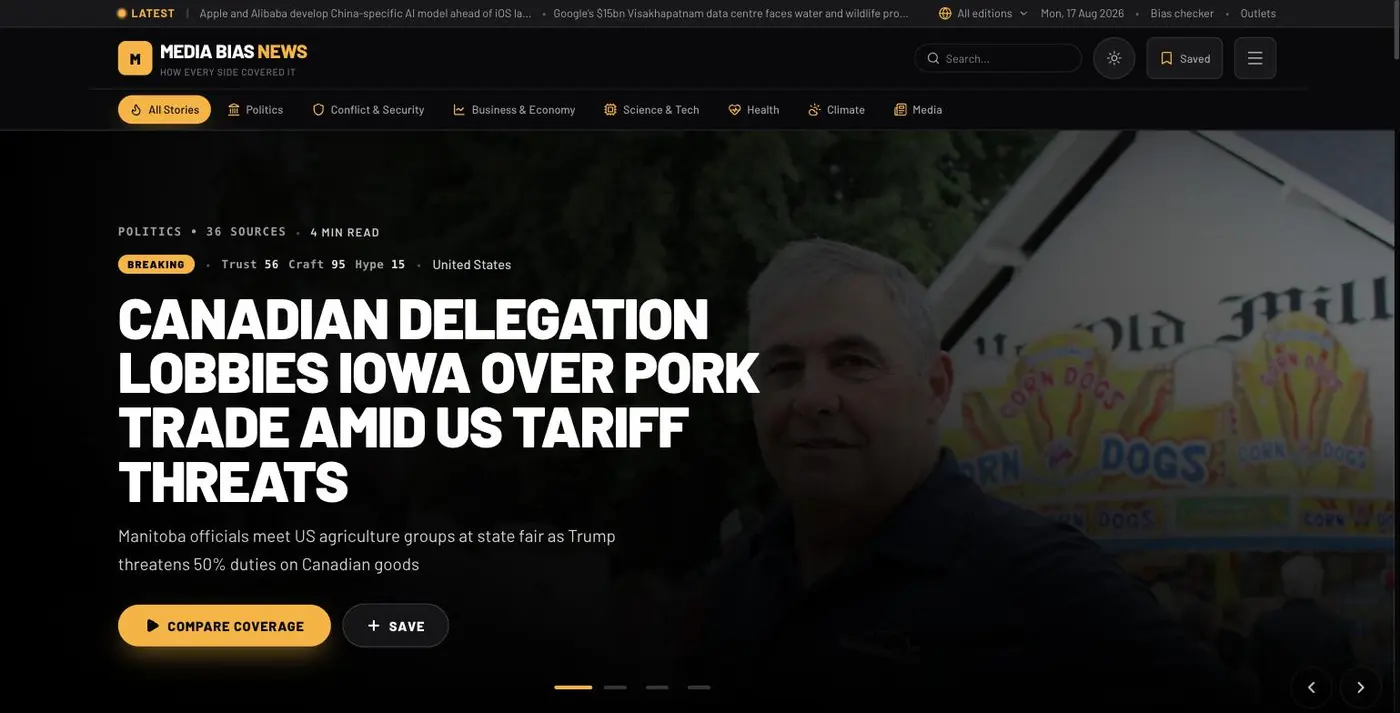
One event, several versions of its importance
Two outlets can report the same event and leave you with quite different impressions. The facts they lead with, the people they quote and the context they include all change what a reader takes away. Sometimes the difference is in what receives almost no coverage at all.
I built MediaBias.news to make those differences easier to see. It brings left, centre and right coverage of a story into one place, with links back to the sources. The comparison is free to read, without creating an account or working through an article limit.
Start with the coverage split
A coverage split shows how the outlets covering a story are distributed across political leanings. It is a useful prompt to look further: why is one group paying more attention, and what does another group emphasise when it does cover the event? The source links let you check the reporting behind that comparison.
A split is about the sources in the sample. It does not describe every article on the internet, and it does not turn an outlet’s political leaning into a verdict on whether a particular claim is true. A small sample can look dramatically lopsided by accident. Source count and corroboration matter alongside the percentages.
Blindspots are especially interesting here. If a story travels widely through one part of the media and barely appears elsewhere, readers can end up with different pictures of what matters. Making that gap visible gives someone a reason to open a source they would otherwise never encounter.
Trust, Craft and Hype ask different questions
The site carries three scores with a story. Trust concerns the evidence and corroboration behind it. Craft concerns the quality of its presentation: context, balance and the separation of fact from opinion. Hype concerns how far the framing runs ahead of the substance.
Keeping those questions separate helps avoid compressing everything into a single good-or-bad number. A story can deserve attention while its headline oversells it. A restrained presentation can still lack enough evidence. The scores are reading aids, and the underlying sources remain the place to investigate a claim.
A comparison needs its own limits
Outlet leanings come from third-party ratings rather than my personal classification of who is fair. That provides a reference point, but it does not remove judgement from the product. Which stories are selected, how sources are grouped and how a summary is written still affect the result.
The project grew out of the news engine behind BarnetPress. Moving from a local news feed to a comparison product changes the editorial question: broad coverage alone is not enough. The useful stories are often those where the framing or attention differs. The aim is to help a reader inspect that difference, while keeping the original reporting within reach.
Useful outside the website too
There is a free API and an open-source agent skill, so the comparison can also appear in a conversation with an AI assistant. A reader asking about a story should be able to get the coverage split and follow the sources without first learning a new interface.
My suggestion is simple: pick a story you already know, compare the coverage, then read a source from another part of the split. Look for a fact, a quotation or a piece of context that your usual coverage did not bring forward. That is the kind of discovery I want MediaBias.news to make easier.
Explore the project